European-style frameless cabinets in CincinnatiClean lines.
More room inside.
European-style cabinets are frameless cabinets. The box has no face frame, so the doors sit nearly edge to edge and each opening is the full width of the cabinet. It’s the construction behind the sleek, modern kitchens many people picture when they say “European.” We design with two frameless lines, Eclipse and Wood-Mode, at our Cincinnati showrooms.
Start with a free design consultation to discuss your goals, inspiration, general budget, and whether East Main is the right fit. Detailed design follows under a paid Design Agreement.
How consultation and design work ↗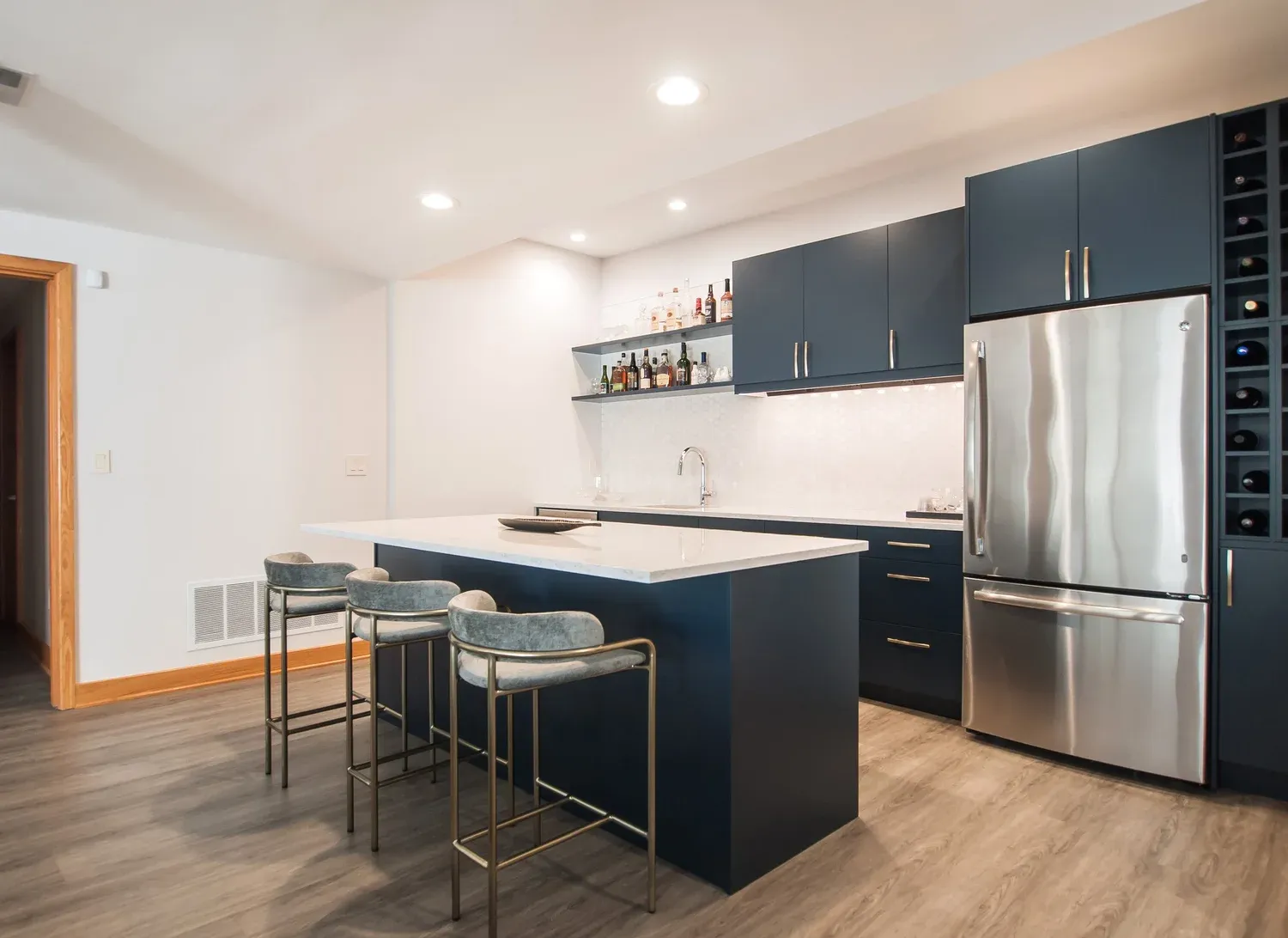
What “European-style” means.
European-style cabinets are built as a plain box with no face frame on the front. You’ll also hear them called frameless or full-access cabinets, or simply European cabinets. The method took hold in Europe after World War II and is often called the 32mm system, after the 32-millimetre spacing of the holes that hold the hinges, drawer runners and shelf pins. It describes how the box is made, not how the kitchen has to look. Eclipse, one of our go-to lines, offers both traditional and contemporary door styles. So euro kitchen cabinets can carry a flat slab door, a slim shaker or something more detailed. Most people choose them for the clean, modern look.
How the box is different.
On a framed cabinet, a solid wood frame is fixed to the front of the box. It helps keep the box square and gives the doors something to hang on. Shiloh, the framed line we design with, uses frames 1 1/2 inches wide on 1/2-inch plywood sides. A frameless cabinet leaves the frame off, so the panels do more of the work. Eclipse builds its boxes from 3/4-inch-thick top, bottom and side panels with a 3/4-inch hanging rail, and covers the front edges with color-coordinated edge banding. The hinges clip onto plates inside the cabinet side. Wood-Mode describes its frameless construction the same way: a cabinet built without a face or front frame.
More room to reach in.
With no frame around the opening, you get the full width of the box. Eclipse puts the gain at up to 10% wider door and drawer openings than a framed cabinet. You notice it most in drawers, and in base cabinets where a large pot or a stand mixer has to pass through the opening. The kitchen doesn’t get bigger. The openings do. If you’re comparing lines, ask to open a framed drawer bank and a frameless one of the same width. Then look at the drawer box and guides that come standard. On Eclipse, that’s a 5/8-inch dovetail or simulated-metal drawer box on Blum soft-close undermount guides, with full-extension guides as an option.
The sleeker, modern look.
Frameless doors and drawer fronts cover almost the whole front of the box. The gaps between them are small and even, and the cabinet ends finish flush. That gives you long, unbroken lines, which is why frameless construction suits a modern kitchen so well. Material does the rest. Eclipse’s flat Metropolitan door comes in gloss and matte acrylic, textured laminates that read as wood grain, high-pressure laminate and reconstituted wood veneers. Its door styles also come in stained or painted wood, with custom paint colors from the Sherwin-Williams palette. Bring photos of kitchens you like. We’ll help you work out whether it’s the door, the finish or the proportions you’re responding to.
Eclipse and Wood-Mode.
We design European-style kitchens with two frameless lines. Eclipse is made by W.W. Wood Products, a family-owned company in Dudley, Missouri, that also builds Shiloh. It introduced Eclipse as its frameless line in 2013. Wood-Mode is the line we use for fully custom work. It has built cabinetry in Kreamer, Pennsylvania since 1942 and offers frameless construction alongside inset. Its modern options include veneer and high-pressure laminate doors as well as solid wood. When a design needs a size, material or detail outside the Eclipse catalog, that’s when we look at Wood-Mode. And if you knew our Oakley showroom as Cooknee Euro Style Cabinets, you’re in the right place. Cooknee is now part of East Main.
Where frameless asks for more care.
Frameless isn’t the right answer for every kitchen. If you love inset doors, which sit inside a face frame, a framed line such as Shiloh is the natural fit. Frameless is also less forgiving to install. A face frame can be trimmed or extended to meet a wall that isn’t straight. A frameless box can’t, and because the gaps between doors are small, anything out of level shows. One carpenter who installs them writes that a quarter-inch difference between the drawings and the room can mean complicated workarounds. That’s why we confirm measurements before ordering and plan the fillers and end panels as part of the design. Our cabinet installation page explains how the boxes are set and fastened.
See the difference
One has a frame. One doesn’t.
The same cabinet built two ways. Open the doors to see what the face frame does to the opening.
Framed
A solid wood frame, 1 1/2 inches wide on Shiloh, sits on the front of the box. The hinges mount on it, and it narrows each opening.
Frameless (European-style)
No frame. On Eclipse the box is 3/4-inch panels with banded front edges. The hinges clip to a plate inside the cabinet side, and the opening is the full width of the box.
Framed and frameless (European-style) cabinets compared, using the published specifications of two lines we design with: Shiloh (framed) and Eclipse (frameless).
| Framed (Shiloh) | Frameless / European-style (Eclipse) | |
|---|---|---|
| Front of the box | A solid wood face frame, 1 1/2 in. wide | No face frame. The front edges of the box are edge-banded |
| Box sides | 1/2 in. plywood | 3/4 in. thick, with 3/4 in. top and bottom |
| Where the hinges mount | On the face frame | On a plate inside the cabinet side |
| Door positions | Standard overlay, full overlay or inset | Full overlay: the doors cover the box |
| What shows around the doors | 1 in. of frame around each door with standard overlay; less with full overlay | A small, even gap, typically about 1/8 in. between doors |
| Openings | The frame narrows each opening | Up to 10% wider door and drawer openings, by Eclipse’s figure |
| Meeting an uneven wall | The frame can be trimmed or extended | Fillers and panels are planned in the design |
| Often chosen for | Traditional and transitional kitchens, and any inset design | Sleek, modern kitchens, though it can carry traditional doors too |
Sources, reviewed November 10, 2026: Eclipse Cabinetry · About and cabinet construction ↗; Eclipse Cabinetry · Product Brochure 7-2026 (PDF) ↗; Shiloh Cabinetry · Cabinet Construction ↗; Shiloh Cabinetry · Cabinet Styles (overlay and inset) ↗; Shiloh Cabinetry · Brochure 2-2026 (PDF) ↗; W.W. Wood Products · About and company history ↗; Wood-Mode · Door Styles (framed and frameless construction) ↗; Wood-Mode · New door styles available in frameless and inset (2022) ↗; Wood-Mode · Heritage ↗; Fine Homebuilding · Installing Frameless Kitchen Cabinets, Aaron Butt (2020) ↗; Fine Homebuilding · Frameless Cabinets With a Traditional Look (1995) ↗; Wikipedia · Frameless construction (citing Jim Christ, European Cabinetry, 1990) ↗; Woodshop News · Understanding 32mm cabinet construction ↗; East Main · Door and drawer adjustments guide ↗. The guidance is East Main’s; confirm specifications for your order with your designer.
A few questions, answered.
- Are European-style cabinets the same as frameless cabinets?
- Yes. In North America, “European,” “euro style,” “frameless” and “full-access” all describe a cabinet box built without a face frame. The method developed in Europe after World War II and is often called the 32mm system. The name refers to the construction, not to where the cabinets are made. Eclipse, for example, is frameless and is built in Missouri.
- Are frameless cabinets as sturdy as framed cabinets?
- A face frame helps keep a framed box square, so a frameless box relies on its panels instead. That makes panel thickness worth checking. Eclipse builds with 3/4-inch top, bottom and side panels and 3/4-inch stretchers. Compare the actual specifications of the lines you’re considering, including the box material, hanging rail and hardware, and ask what testing the cabinets have passed.
- Do European-style cabinets have to look modern?
- No. Frameless is a way of building the box. Eclipse offers both traditional and contemporary door styles, so the same construction can carry a shaker or a raised-panel door. Most people choose euro style cabinets for flat slab doors and a sleek, modern look, but it’s the door, finish and hardware that set the style.
- Can I have inset doors on frameless cabinets?
- Inset doors sit inside a face frame, flush with it, so they belong to framed construction. If inset is the look you want, we’ll point you to a framed line. Shiloh offers several inset options, and Wood-Mode builds inset cabinetry as well. Some homes use both: frameless in the kitchen, for instance, and inset for a hutch or a bar.
- What’s the difference between Eclipse and Wood-Mode?
- Both offer frameless construction. Eclipse is our semi-custom frameless line, with a broad catalog of door styles, laminates, veneers and paint colors. Wood-Mode is the line we use for fully custom work, when a kitchen needs a size, material or detail outside a catalog. We’ll compare the two against your design and your budget.
Let’s make a plan
Your kitchen starts with a conversation.
Start with a free design consultation to discuss your goals, inspiration, general budget, and whether East Main is the right fit. Detailed kitchen design follows under a paid Design Agreement.